
In the History of Pseudonyms, “Shakespeare” Fits Right In
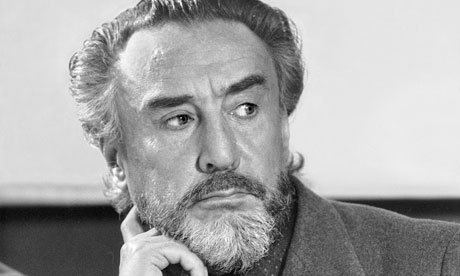
Romaine Gary, alias Emile Ajar, enlisted his cousin to be the public face of Ajar.
Imagine a celebrated author who publishes under a pseudonym. Only his wife and a few associates know his secret. His works achieve such extraordinary success that he decides he needs a front man—a public face. He recruits and coaches a younger man to embody his alter ego, even scripting details about the author’s “real life.” Everyone is fooled.
This scenario may sound like something drawn from the Shakespeare authorship question, which asks whether the true author wrote under the pseudonym “William Shakespeare,” using William Shakspere of Stratford-upon-Avon as his stand-in.
But it is also a true story.
French novelist Romain Gary remains the only writer to win the prestigious Goncourt Prize twice—first under his own name, and then under the pseudonym Émile Ajar. To sustain the illusion, Gary enlisted his cousin, Paul Pavlowitch, to play Ajar in public, even preparing him for meetings with his publisher, who was completely convinced by the performance.
The ruse ultimately unraveled when Gary revealed the truth in a novel narrated by Pavlowitch, who confesses to being Ajar. Soon after, Pavlowitch ended his cooperation, and the deception came to an end.
Carmela Ciuraru recounts this remarkable episode in Nom de Plume: A (Secret) History of Pseudonyms, a book that examines eighteen writers who adopted pseudonyms or heteronyms, including George Sand, Lewis Carroll, Mark Twain, Isak Dinesen, and Christian Brulls.
From Ciuraru’s survey, four principal motivations for pseudonymity emerge. The most common—shared by at least seven of the authors she profiles—is the desire to create an alter ego: a different self, liberated from the expectations and constraints attached to one’s real identity.
The remaining motivations, distributed among the other authors, include:
avoiding discrimination (particularly against female writers, as in the cases of the Brontë sisters and Marian Evans, who wrote as George Eliot);
concealing authorship of controversial or taboo material (as Dominique Aury did when publishing The Story of O as Pauline Réage);
and distancing oneself from perceived shame or social disapproval (as with Henry York, who became Henry Green, and Eric Blair, who became George Orwell).
Ciuraru also makes clear that authors often act from multiple motivations at once.
Seen in this light, Edward de Vere—the strongest alternative candidate for the authorship of the Shakespeare canon—fits this pattern remarkably well, aligning with at least three of these four motivations.
First, de Vere was a nobleman in a culture that frowned upon aristocratic involvement in the theater. Though recognized in his time as a gifted poet and playwright, he would have had strong social incentives to conceal his authorship. Ciuraru’s account underscores how, even centuries later, writing could still carry a stigma in elite circles.
Second, much of the content of the Shakespeare plays would have been politically sensitive—especially if written by a court insider. Numerous characters appear to mirror real figures from the court of Queen Elizabeth I. For example, Polonius in Hamlet is widely interpreted as an unflattering portrait of William Cecil, Lord Burghley—de Vere’s father-in-law and a man with whom he had a strained relationship. Likewise, Queen Gertrude is often seen as reflecting Elizabeth herself.
Third, as Charles Beauclerk argues in Shakespeare’s Lost Kingdom, the Shakespeare persona may represent de Vere’s expressive alter ego—a freer, more bohemian self through which he could channel personal and political tensions. Beauclerk further contends that the plays are “politically inflammatory works,” written from within the very system they critique.
Ciuraru’s broader contribution—without directly addressing the Shakespeare question—is to demonstrate the plausibility of attaching a pseudonym to a real person who performs the role of the author.
In that context, the idea of William Shakspere of Stratford playing “William Shakespeare” as a stand-in for de Vere no longer seems far-fetched.
There is also evidence suggesting that “William Shakespeare” itself functioned as a pseudonym. As noted by Margot Anderson in Shakespeare by Another Name, the name frequently appears in print as “Shake-speare.” In Elizabethan usage, such hyphenation often signaled a constructed or symbolic name. Notably, when King Lear was briefly published under the spelling “Shak-speare,” later editions reverted to “Shake-speare.”
The Sonnets, too, were published under this hyphenated form.
Meanwhile, the man from Stratford never signed his name as “Shakespeare,” but consistently as “Shakspere” or similar variants. His official records—birth, family, and burial—reflect these shorter forms. His will contains no mention of plays, books, or any literary activity.
By contrast, the parallels between de Vere’s life and the Shakespeare canon are extensive—so much so that they have been read by some as autobiographical. The Sonnets, written in the first person, likewise align more closely with de Vere’s biography than with that of the Stratford man.
De Vere had the motive, the opportunity, and the ability to adopt a pseudonym—and to employ a front man. As Ciuraru shows, it is not uncommon for authors to draw pseudonyms from real individuals. “George Sand,” for instance, derived in part from the name of her associate Jules Sandeau.
“Shakespeare,” a close variation of “Shakspere,” would have made the Stratford man’s role as a public figure all the more convincing—an ideal solution for a nobleman seeking anonymity.
In the long and varied history of pseudonyms, such a literary masquerade is not merely conceivable. It is, in fact, entirely plausible.