
Was Hamlet Banned?
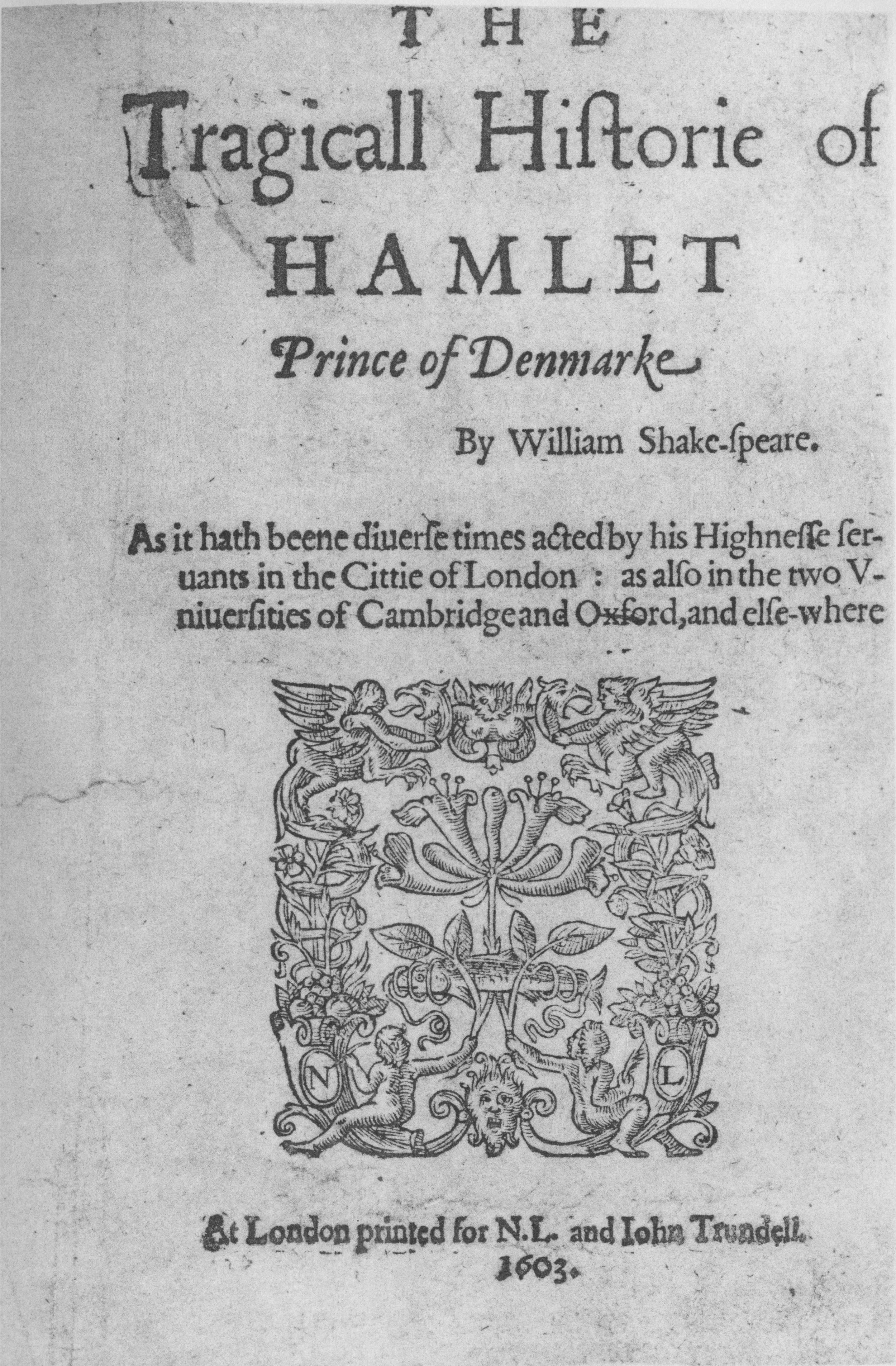
Many consider it the greatest play ever written, an iconic masterpiece that has endured for more than four centuries: Hamlet, Prince of Denmark.
And yet, for a time, did Shakespeare’s most celebrated work run afoul of government censors? Was Hamlet banned during the reign of Queen Elizabeth I?
The performance record
Hamlet was first published in 1603, though no one knows exactly when Shakespeare wrote it.
Only four pre-1603 references to the play survive:
A preface by Thomas Nashe to Robert Greene’s 1589 prose work, in which Nashe writes of another author: “[I]f you entreat him fair in a frosty morning, he will afford you whole Hamlets—I should say handfuls of tragical speeches”
A record of a 1594 performance staged by Philip Henslowe at Newington Butts
A 1596 book by Thomas Lodge referring to a performance outside London
The registration of Hamlet in the Stationers’ Register in 1602, securing exclusive rights to print the play
In addition, there is evidence that Gabriel Harvey mentioned Hamlet in notes to a 1598 edition of Chaucer, though it is unclear when those notes were written, and the edition itself has not survived.
Thus, over the thirteen years following 1589—the earliest known reference to Hamlet—the play appears in the historical record just four times.
The play is not even included among the twelve Shakespeare plays listed by the clergyman Francis Mere in his 1598 book, Wit’s Treasury. G.R. Hibbard concluded that “[Hamlet’s] absence from that list amounts to strong presumptive evidence that it had not been staged.”
Hibbard was referring to the first edition of Hamlet, printed in 1603. He is among the scholars who speculate that an earlier play—called the “Ur-Hamlet”—was written by someone other than Shakespeare, and that this lost work is the one referenced prior to 1602. (The prefix “Ur-” derives from a German word meaning “original”.)
Other scholars (including Harold Bloom) have dismissed the “Ur-Hamlet” theory, maintaining that Shakespeare, and no one else, wrote the Hamlet referred to in 1589, 1594, and 1596.
One explanation for the sparse mention of Hamlet before 1602 is that the play was performed often, but the performance records didn’t survive. That’s certainly possible, but for those who think only Shakespeare wrote Hamlet, it still begs the question why the Bard’s best-known play is absent from Francis Meres’ 1598 list.
And if Hamlet existed no later than 1589, why did it take fourteen years to be published—when at least eleven other Shakespeare plays, roughly a third of the canon, had already appeared in print before 1603?
Corambis aka Polonious aka William Cecil
Another explanation for the scarcity of references to Hamlet prior to 1602 is that the Crown suppressed the play. It’s not hard to see why.
For 150 years, scholars have concluded that the character Polonious represents William Cecil, Lord Burghley, who was Lord Treasurer under Queen Elizabeth. A Machiavellian spymaster under Francis Walsingham, Burghley was the most powerful man in England during Elizabeth’s 40-year rule.
In Hamlet, Polonius is a pompous, meddling, long-winded counselor to Claudius, the man who has poisoned Hamlet’s father. When Polonius spies on him, Hamlet kills him—a pivotal turning point in the play.
In the first version of Hamlet, published in 1603, the king’s counselor is not named Polonius but Corambis—a name that echoes Burghley’s motto, cor unum (“one heart” in Latin). By contrast, “Corambis” suggests “two hearts,” implying duplicity.
Other links between Polonius and Burghley appear in the advice Polonius gives his son—lines that closely resemble the moral precepts Burghley wrote for his own son.
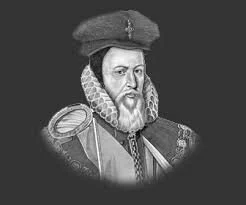
Lord Burghley was the most powerful man in England during Elizabeth I’s forty-four-year reign.
It is difficult to imagine the most powerful nobleman in the queen’s court quietly allowing himself to be lampooned on the public stage. It is equally doubtful that Queen Elizabeth would have tolerated Hamlet, given her close association with Burghley. She tended him on his deathbed and went into deep mourning when he died in 1598.
Remember 1598?
That was the year Francis Meres published his list of Shakespeare’s plays. It would have been prudent to omit a work that mocked Burghley and, by extension, the queen herself.
Nor would it be surprising if Elizabeth recoiled at being mirrored in Queen Gertrude.
At the start of Hamlet, Gertrude has recently married her husband’s poisoner, Claudius. Elizabeth’s longtime favorite, Robert Dudley, Earl of Leicester, had a reputation as a poisoner, and some scholars see Claudius as reflecting him. Claudius swiftly marries Hamlet’s mother and takes the throne, passing over the queen’s son.
Hamlet repeatedly accuses Gertrude—his mother—of incest for marrying his uncle. The subject had to be a sensitive one for Elizabeth, whose mother, Anne Boleyn, was executed on charges of incest and adultery. Elizabeth herself, as a teenager, was entangled in a sexual scandal involving her stepfather.
How, then, could Shakespeare have written and staged Hamlet? The short answer is: perhaps he did—but not for long.
Muzzling the Dogs
Freedom of expression in Elizabethan England was tightly controlled. The Crown licensed all printed material and could ban theatrical performances at will.
It did just that with The Isle of Dogs, a play by Thomas Nashe and Ben Jonson. Though the text has not survived, contemporary accounts describe it as “lewd” and “scandalous,” and it may have satirized the queen. The Privy Council moved swiftly to shut it down.
It is not hard to imagine Hamlet—if perceived as mocking Elizabeth, Burghley, and Leicester—meeting a similar fate.
This possibility could explain the play’s sparse early record and its absence from Meres’s list. It may have resurfaced quietly in 1594 after suppression in the late 1580s. Ultimately, however, the Crown could not keep Hamlet underground.
The Queen Is Dead, Long Live Hamlet
Hamlet appeared in print only after Elizabeth’s death. The title page of the 1603 quarto states that the play had been “diverse times acted by his Highness servants in the City of London,” referring to the company under the new king, James I.
By then, Elizabeth, Burghley, and Leicester were no longer alive to object.
Burghley’s son, Robert Cecil, however, remained in power as James’s secretary. Even if he could not keep the play suppressed, the name Corambis was changed to Polonius in the 1604 version and all subsequent editions.
The idea that Hamlet was suppressed during Elizabeth’s reign remains a theory. Yet it offers a coherent explanation for the scarcity of early records and the play’s omission from Meres’s list—arguably as persuasive as competing theories involving an “Ur-Hamlet” or lost performance history.