
From No Name to Shakespeare… or Not
Imagine you’re an author. Your first publication—a long poem—is a huge success. Within a year, you publish a second poem, another hit.
Your plays, too, have been staged and well-received. You expect the plays should do well in print. After all, readers will see your name on them, right?
Well, no, not if you’re William Shakespeare.
Shakespeare plays, but no Shakespeare
William Shakespeare first achieved fame as a poet. His narrative poem, Venus and Adonis, was published in 1593 and went through seven printings in as many years. His other long poem, The Rape of Lucrece, appeared in 1594. It, too, enjoyed fine success. Both poems had his name on them.
His plays appeared in print beginning in 1594 with Titus Andronicus. However, the play didn’t name the author. For several more years, none of the first editions of Shakespeare’s plays displayed his name.
In addition to Titus Andronicus, these anonymous plays were Henry the Sixth, Part 2 (1594); Henry the Sixth, Part 3 (1595); Richard the Second (1597); Richard the Third (1597); and Romeo and Juliet (1597).
It’s baffling why a publisher would leave off a best-selling author’s name from their work. There are several explanations, but no definitive answer.
Shakespeare emerges as a playwright
Finally, in 1598, readers who frequented London bookstalls could purchase the first play attributed to Shakespeare: Love’s Labour’s Lost.
Over the next five years, other plays bearing Shakespeare’s name followed: Henry the Fourth, Part 1; Much Ado About Nothing; Midsummer’s Night Dream; Merchant of Venice; Henry the Fourth, Part 2; Merry Wives of Windsor; and Hamlet.
Oddly, however, further editions of most of his plays printed before 1598 remained unattributed, including Titus Andronicus, Henry the Sixth Parts 2 and 3, Romeo and Juliet, and Henry the Fifth.
Many of these anonymous plays (including the five listed above) were not attributed to Shakespeare in print until the publication of the First Folio) in 1623.
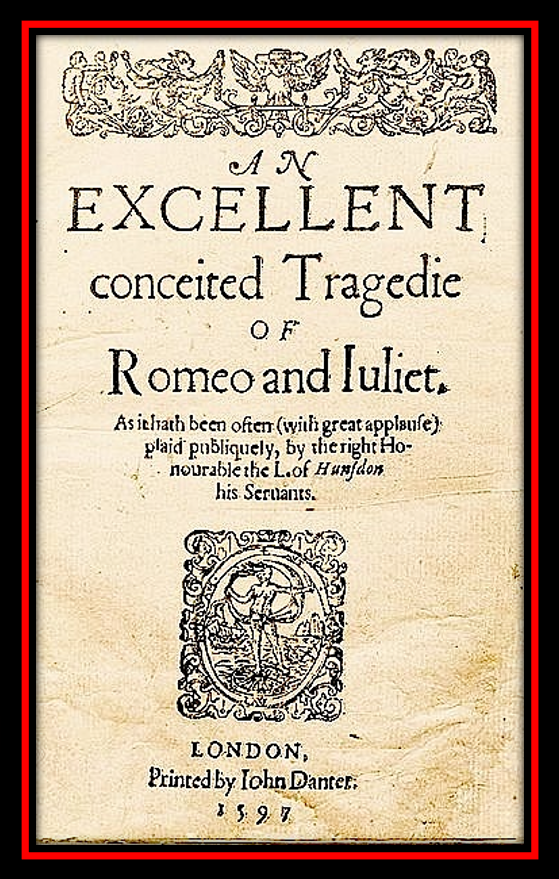
Remarkably, the first three quarto editions of Romeo and Juliet—Q1 (1597), Q2 (1599), and Q3 (1609)—did not name Shakespeare as the author, though his name had begun appearing on other plays in 1598.
Traditional Explanations
Why were some of Shakespeare’s most popular plays printed without attribution, even while others did name him as the author? Traditional explanations include:
Elizabethan plays weren’t thought of as literature until after 1600.
The title page of most plays during the 1590s didn’t name an author.
Some playwrights were never named on a title page while they were alive.
In the case of John Lyly, some of his plays were published over a dozen years until his name appeared on a title page in 1597.
When it comes to Shakespeare, however, these explanations prove unsatisfactory. His name appeared on some of his plays after 1597. The question is, why not on all of them?
Venus and Adonis and The Rape of Lucrece each showed Shakespeare as the author and were back-to-back best-sellers. Publishers were profit-motivated. They should have been keen to attach the poet’s name to his plays.
To increase sales, why not attribute Titus Andronicus, Henry the Fifth, Henry the Sixth, and Romeo and Juliet to William Shakespeare?
By 1598, Love’s Labour’s Lost had been printed with attribution to Shakespeare, followed by Much Ado About Nothing, A Midsummer Night’s Dream, Merchant of Venice, and other popular Shakespeare plays.
Yet second editions of most of the anonymous Shakespeare plays stayed unattributed, including the second edition of Romeo and Juliet (1599).
These facts distinguish Shakespeare from the case of John Lyly. It simply makes no sense that publishers didn’t attribute Shakespeare’s plays because they didn’t consider them “literature.”
After 1598, it would appear foolish for publishers not to attach the Shakespeare brand to his previously unattributed plays—unless they had other reasons not to do so.
A Different Theory
The content of the certain plays may explain why Shakespeare’s name wasn’t attached to them, even after 1598. The plays in this category are Titus Andronicus, Henry the Sixth Parts 1 and 2, Romeo and Juliet, and Henry the Fifth.
In each case, one can argue that the play contained material that offended the authorities—in particular, Queen Elizabeth I—such that Shakespeare or the publisher, or both, concluded it was best the play’s author remain anonymous.
Shakespeare and Elizabeth: No Love Lost?
Shakespeare mirrored real persons in his plays. In Love’s Labour’s Lost, even the characters’ names mimic the people they reflect.
Scholars have long associated the windbag Polonius in Hamlet with Lord Burghley, Queen Elizabeth’s closest adviser. In the same play, Elizabeth can be seen as Queen Gertrude, the incestuous adulteress, and Elizabeth’s long-time consort, the Earl of Leicester, as Claudius, the notorious poisoner.
It’s easy to understand why Hamlet wasn’t published until after the deaths of Burghley, Elizabeth, and Leicester. I have argued that the Crown banned Hamlet during Elizabeth’s lifetime.
Marc Shell has observed, “Shakespeare apparently was not a great admirer of Elizabeth. Unlike most English poets of the age, for example, he did not write a word of direct mourning on her death.”
In The End of Kinship, Shell speculates that the character Isabella in Measure for Measure is modeled on Elizabeth, though “[o]ne cannot make an airtight case . . . [W]ere that possible on the basis of what is said in [the play], Shakespeare might have been open to charges of treason.”
Margo Anderson, in Shakespeare By Another Name, calls Elizabeth “the leading candidate” for Lady Macbeth.
This may help explain why Measure for Measure and Macbeth, like Hamlet, didn’t appear in print until after Elizabeth’s death.
Elizabeth the Adulteress
Titus Andronicus is another play which appears to mirror Elizabeth and Leicester, in this instance in the characters of Tamora and Aaron the Moor. In the play, Tamora and Aaron engage in adultery, which produces a child.
Charles Beauclerk, in Shakespeare’s Lost Kingdom, says:
Tamora, a composite of Queen Elizabeth and Mary Queen of Scots, is ruled by her passions, creating chaos in government and devouring her own children. Her affair with Aaron the Moor threatens to become a national scandal when she is delivered of a child by him. Bearing in mind that the Queen of England used to call the Earl of Leicester her “Moor,” we can conclude that the incident is clearly meant to reveal one of the darker secrets of the Elizabethan state.
Though Shakespeare may not have been a big fan of Elizabeth, he likely had a close connection with her court. Both of his long poems were dedicated to the highly popular Earl of Southampton. Many believe Southampton is the “lovely boy” of Shakespeare’s Sonnets.
Southampton’s dealings with Elizabeth were rocky—she imprisoned him for treason—and he may have had a not-so-positive attitude towards her similar to Shakespeare’s.
Readers knowing that the court-connected Shakespeare wrote Titus could have easily seen how Tamora’s relationship with Aaron paralleled Elizabeth’s relationship with Leicester. Leaving Shakespeare’s name off the play would have been the wise thing to do.
Elizabeth the Amazon
Elizabeth and Leicester show up again in Henry the Sixth, Part 2 and Henry the Sixth, Part 3, in the characters of Margaret and Suffolk, illicit lovers who dominate affairs of state and mirror the real-life power duo of Elizabeth and Leicester.
In these plays, Elizabeth is mirrored as the “Amazon” Margaret, the rather cruel adulteress warrior who leads the Lancastrian army army in the War of the Roses.
Leicester—deemed a notorious poisoner by many—is mirrored as Suffolk, whom Shakespeare repeatedly links to poisoning.
These could have been reasons not to attribute the plays, but there may have been another: their major theme is succession to the throne. Shakespeare may have been commenting on Elizabeth’s own succession, which, as with Measure for Measure, could have exposed him to accusations of treason.
Elizabeth the Envious
In Romeo and Juliet, Romeo sees Juliet at a window above him and says:
But, soft! what light through yonder window breaks?
It is the east, and Juliet is the sun.
Arise, fair sun, and kill the envious moon,
Who is already sick and pale with grief,
That thou her maid art far more fair than she:
Be not her maid, since she is envious;
Her vestal livery is but sick and green
And none but fools do wear it; cast it off.
The moon was a familiar symbol for Elizabeth. Percy Allen, in his 1932 biography of Edward de Vere (whom many believe was Shakespeare), observed:
[t]he references [in Romeo and Juliet] are unmistakable for when it is remembered that the Tudor livery was green and white, the envious moon, or Diana as she was so frequently called, whose vestal livery is “sick and green,” can be none other than Queen Elizabeth.
In subsequent decades other Shakespeare researchers, such as Dorothy and Charlton Ogburn, Sr. and Charles Beauclerk, have agreed with Percy, noting parallels between the story in Romeo and Juliet and the love relationship between de Vere and Anne Vavasour, one of Elizabeth’s maids of honor.
There’s strong evidence that de Vere and Elizabeth were also romantically involved. In this view, Shakespeare, through the character of Romeo, calls Elizabeth envious (not once, but twice) and in a rather vicious manner—“Arise, fair sun, and kill the envious moon.”
With such an insult aimed at the Queen of England, it would be no surprise that an author with court connections, his publisher, or both chose to publish the play anonymously.
Indeed, none of the first three editions of Romeo and Juliet bear the author’s name.
Elizabeth the Queen, but who’s next?
Henry the Fifth (1600) was published during a time when factions in Elizabeth’s court were jockeying for position in preparation of her succession. She had only a few years left to live.
One of those factions favored Robert Devereux, the Earl of Essex, a charismatic soldier who got in trouble with Elizabeth after the military campaign he led in Ireland failed. Ultimately, Essex was executed.
Around the same time, the historian John Hayward wrote a book about how King Richard the Second was deposed. The book contained a dedication praising Essex. The Crown feared Hayward intended Richard of Second to serve as a model for overthrowing Elizabeth. For years Hayward was jailed in the Tower of London.
Many scholars agree that Shakespeare gives cryptic praise to Essex in Henry the Fifth. Could Shakespeare, in the same play, be signaling support for Essex’s ally, the Earl of Southampton—the same courtier to whom Shakespeare dedicated both long poems—to be the next King of England?
Arguably, Shakespeare sent this message by using markers in the play—including the name Southampton and the earl’s military role in Ireland—which link him to King Henry (Southampton’s birth name was Henry Wriothesely). This would also suggest, however subtly, that Southampton was Elizabeth’s son—a dangerous implication indeed.
For these reasons, anonymity would be the better part of wisdom when it came to publishing Henry the Fifth.
In separate essays, I will discuss the Elizabeth, Leicester, and Southampton markers in more detail, as well as how succession theme of the Henry the Fifth and Henry the Sixth plays mirrors Elizabeth’s own succession crisis.
Of course, all of this is just a theory based on the content of certain Shakespeare plays, to explain why they remained anonymous after others began showing his name.
In any case, one hopes further research in this area extends beyond traditional explanations, as well as beyond orthodox assumptions about who Shakespeare really was.